
The Catclaw Acacia
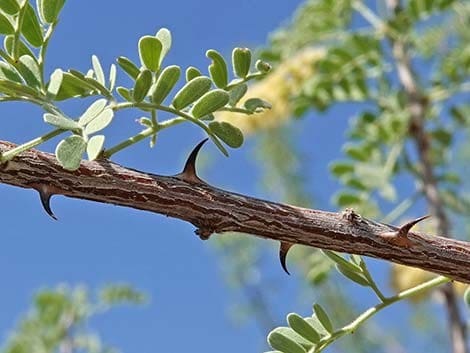
Wait a minute… wait a minute… wait just a minute – it’s got me! Catclaw acacia ranges in size from a five-to-six-foot shrub to a compact tree with a canopy six to 20 feet across, depending upon how much water is available in the location where it is growing. No matter the size, from new seedling to mature tree, this member of the pea family (Fabaceae) commands respect! It earns both of its common names (“catclaw” and “wait-a-minute bush”) by snaring unwary passers-by with its sharp, curved thorns. Clothing can be ripped beyond repair and skin lacerated if the backward-curving thorns are not handled very carefully. Cats’ claws, indeed, and the “wait a minute” may take more than just a “minute” as anyone unlucky enough to be tangled in it tries to escape.
Catclaw grows naturally in sandy washes, canyons, and on alluvial fans in North America’s Mojave and Sonoran Deserts. At Clark County Wetlands Park, it is found most frequently in the desert scrub community on the dry, north side of the Las Vegas Wash. There, it favors desert washes where rare desert rains flow downhill and provide it with as much as two to three deep waterings over a year. However, it is tolerant of most soils and makes occasional appearances in the areas closer to water, including near the entry pavilion of the Park’s Nature Center and at the foot of the complex’s ramp on the way to Vern’s Pond.
Catclaw leaves are small and gray-green in color, with rounded tips on the compound leaflets. Its drooping, caterpillar-shaped cream-colored flower spikes add beauty and a wonderfully pleasant fragrance to the spring landscape. Catclaw blooms most heavily in April and May but may flower on through October if the summer monsoon provides sufficient rainfall.
The creamy, fragrant flowers are pollinated by a variety of bees, hovering flies, wasps, butterflies, and even ants. The wide, flat brownish fruits that follow the flowers are often twisted or curled and contain dark brown seeds that look like lentils. Catclaw flowers are an important source of honey, and the seeds are eaten by small mammals and birds.
Because the curved cat-claw-like thorns make an excellent barrier, catclaw serves as protective habitat for many kinds of wildlife. Verdins and other bird species nest in Catclaw shrubs and trees. Its thorns protect small mammals and reptiles and shield their burrow entrances from digging predators. Small animals and birds lucky enough to nest or burrow near a catclaw can count on long-term residences. Individual catclaw plants may live 200 years or more!
Even people have found many uses for catclaw. Native Americans gathered and processed the lentil-like seeds for food. They used catclaw pods, leaves, and roots to treat such diverse ailments as conjunctivitis, diarrhea, cough, sore throat and diaper rash. In home landscapes, it can be shaped to provide handsome shade trees, and its thorns make it an ideal barrier plant – if those managing the landscape are skillful (and careful) about keeping it pruned.
For a safe look at catclaw trees, check out the ones growing just south of the entry pavilion on the way in from the Nature Center parking lot. They are easy to approach without getting “too close,” and the spring fragrance (and pollinator traffic) when they are in bloom makes them very attractive!
– By Chris Leavitt, President; photo by Jim Boone, birdandhike.com
Please enjoy these YouTube videos:
CATCLAW ACACIA Senegalia greggii in the Anza-Borrego Sonoran Deserrt formerly Acacia greggii
BATTLEFOXX LIVING EARTH – Nature, Cota de Casa 4:54
Catclaw Acacia, natural to the Sonoran Dedesrt
Kelly Athena 0:19