
The Desert Blond Tarantula
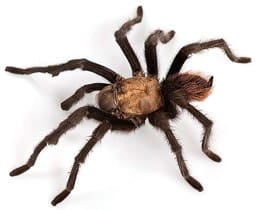
WHAT WETLANDS PARK RESIDENT HAS EIGHT EYES, EIGHT LEGS, AND “STINGING” HAIR?
“Stop right there! Any closer, and I WILL bite!” My husband Bob and his archaeological crew returned to their field vehicle after a day of survey work to find a male tarantula threatening to bite its front tire! The spider was reared up on his back four legs with the front four raised in threat posture and his fangs fully erect, determined to make that suburban back off! He was likely on an evening courtship hike, looking for a receptive female and had no idea how overmatched he was! The crew moved him gently off to the side in the direction he was traveling before they headed home.
Desert blond tarantulas are also called western desert tarantulas, Arizona blond tarantulas, and Mexican blond tarantulas. This reflects their range, which includes the deserts of southern Nevada, southern California, New Mexico, Arizona, and northern Mexico. Though their range is limited, these large, gentle spiders are often common in habitats (from desert scrub to mesquite woodlands) that support them.
The spiders live in burrows up to two inches in diameter and a foot deep that angle off to a side chamber where the spider rests. The silk burrow lining includes long strands of silk that extend out from the entrance to alert the spider to the possibility of a meal. They hunt by night within a few yards of their burrows for prey including crickets, beetles, grasshoppers, cicadas, caterpillars, other spiders, and even small lizards.
Tarantulas rest in their burrows by day, sheltered from extremes of heat and cold, and from an array of predators including birds, coyotes, foxes, lizards, snakes, and most notoriously, Pepsis (a.k.a. “Tarantula”) wasps. These large shiny black wasps with bright orange wings sting the spiders to paralyze them, then drag them to prepared burrows where they lay an egg on top of dormant spiders and seal the entrance of the burrows. The emerging wasp larvae then have a good source of fresh food.
Desert blond tarantula spiderlings dig their burrows when they leave their mother’s burrow at about one week old and modify and enlarge them as they grow. Males keep their burrows until their final molt at about 10 years old, then leave them to become travelers in search of mates. Females may occupy the same burrow for their entire lives, which can be up to 20 years!
Female desert blond tarantulas are larger than males, with lengths of three to five inches, relatively heavy bodies, and leg spans up to six inches. Mature males have longer, more slender legs than females, with specialized hooks called pedipalps on the front pair of legs. These are used to hold the female’s fangs while mating to prevent the male from being eaten! The “blond” in the common name comes from the relatively light color of the carapace relative to the darker legs (especially in males) and abdomen.
Despite their formidable size, desert blond tarantulas are not dangerous to humans. Even a spider that has never met a human before generally will not bite unless it is roughly handled. Though their large fangs can produce a painful bite and their venom will kill small prey, bites in humans produce only slight swelling, numbness, and itching.
The spiders do, however, have one more defensive card to play! Their abdomens are covered with loosely attached barbed “urticating” hairs. These hairs sting like nettles, and a threatened spider can use its hind legs to brush or fling these hairs into the eyes and nose or onto the exposed skin of an attacker. The hairs are extremely irritating to mucus membranes and can cause an itchy rash on human skin. While many wild tarantulas will just calmly walk around on an offered hand. it is best (as with all wildlife) to view them with your eyes only!
Especially in late summer into fall, keep watch for Wetlands Park’s resident desert blond tarantulas. Males (in particular) may sometimes be seen crossing the trails, walking very deliberately and seeming to use care and caution about where they set each foot, especially early in the morning and in the evening. Females are rarely far from their burrows, so seeing one of these lovely ladies out and about in the open is a real treat – if you get lucky, just stay still and watch!
– By Chris Leavitt, President; photos from Wikipedia
Please enjoy these YouTube videos!
Desert Tarantula (Aphonopelma chalcodes)
Alejando’s Adventures 0:59
Creature feature: The Arizona Blond Tarantula
The Reptile Zoo 0:22
Spider Queen of the Sonoran Desert: Aponopelma chalcodes Tarantula
Tarantula Collective 14:49