
The Yellow-breasted Chat
WHAT WETLANDS PARK SUMMER RESIDENT IS MORE OFTEN HEARD THAN SEEN?
Is that really only one bird singing? It isn’t a mockingbird, is it? It sounds like a jazz musician improvising!
Yellow-breasted chats (Icturea virens) are often heard well before they are seen, even though they all wear bright yellow “vests.” Their song includes what has been described as a mixture of caws, whistles, rattles, squeaks, scolds, grunts and mews. In addition, they may call to each other with a “grating ‘chack’!” Quite a “chatty” repertoire, and like mockingbirds, they may sing day or night!
Yellow-breasted chats are the only birds in the family Icteriidae. They were classified as members of the warbler family (Parulidae) for decades before being assigned to their own family in 2017.
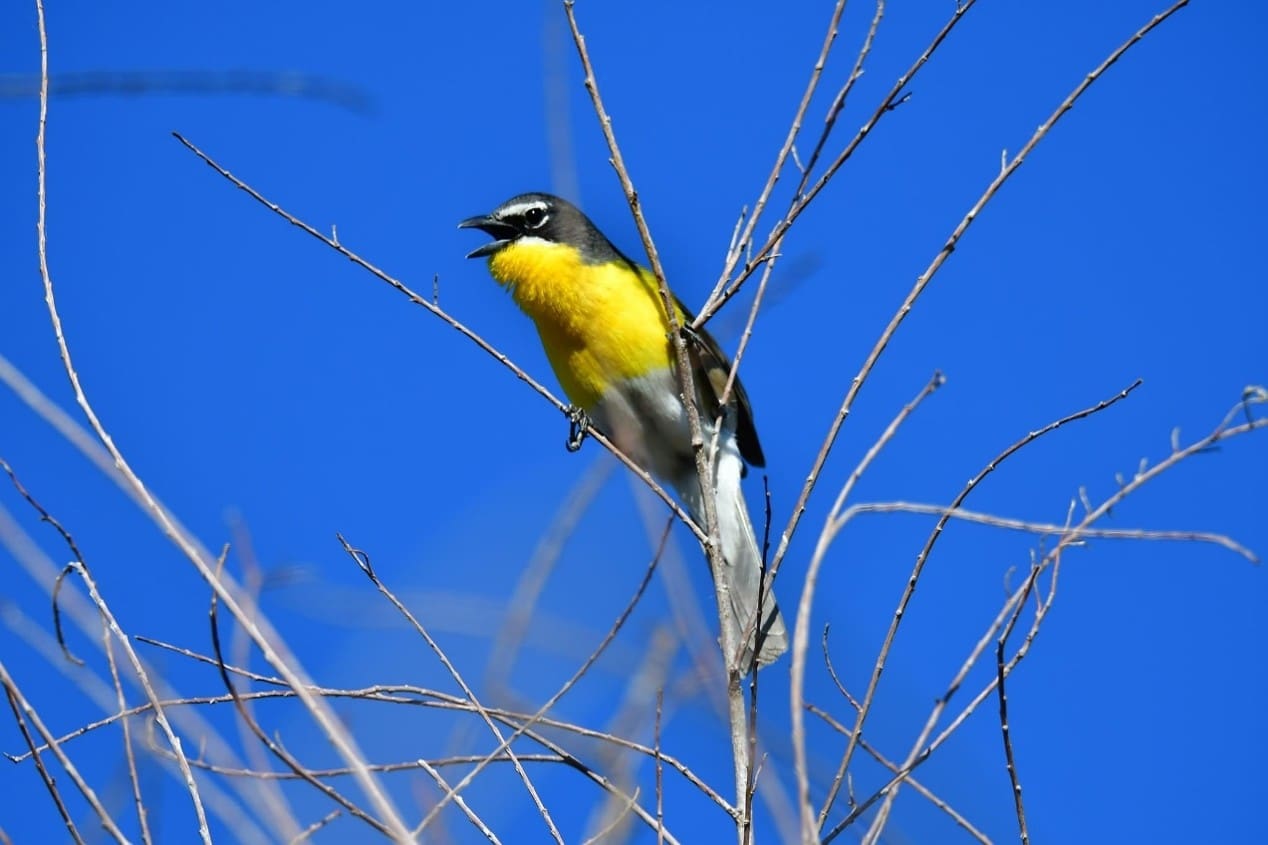
These songbirds are about seven and a half inches long, with long tails and relatively short, stout bills. Both males and females are dark olive colored above, with yellow throats and breasts. They have white “spectacle” markings around their eyes and white “moustache” stripes. Their color is striking, but they can be difficult to see, even when they can be heard clearly, since they are often well hidden in dense brush. Our photo model just happened to be singing in the open when his portrait was taken!
Chats have a large breeding range across North and Central America in habitats with dense vegetation. Most migrate to Central America in the winter. They are common summer residents at Clark County Wetlands Park, where they particularly favor the dense, brushy and thicket habitats along the Park’s streams and pond margins.
The birds forage low in the shrubbery, gleaning a wide variety of insects including grasshoppers, bugs, beetles, weevils, bees, wasps, tent caterpillars, ants, moths and mayflies from the dense vegetation. Occasionally they will grip food items in their feet before they begin to eat. They consume about as much fruit (including wild grapes) and berries (including blackberries) as they do insect prey.
As you walk the Park trails, listen for chats making “scolding” sounds from within dense thickets. If you are patient and try making a few “pishing” sounds, you may be able to coax one of the birds into view, even if only for a short time! What a treat!
– By Chris Leavitt, Board President; photo by Philip Martini
Please enjoy these YouTube videos!
Yellow-breasted Chat/The bird who confounded scientists for years
All Things Birdie 6:28
Yellow-breasted Chat on 05.01.23
BK’s Wildlife World 0:45
Bath time for Yellow-breasted Chat
Owlice333 0:15
Icteria virens YELLOW-BREASTER CHAT foraging, eating worms
Rob Curtis Nature Videos 10:21