The Yellow Warbler
What Cheery Bird Populates Wetlands Park at This Time of Year?
The yellow warbler (Setophaga petechia; often called the Northern Yellow Warbler)is one of the brightest and most cheerful birds found in Clark County Wetlands Park. Its brilliant yellow feathers make it easy to spot among the trees and shrubs along the park’s waterways. Although small, this colorful songbird brings life and movement to the wetland habitat, especially during the spring and summer months.
According to Alex Harper, founder of Nature in Mind, biologist, birding guide, and educator based in Las Vegas—and recent lecturer at the Park’s and Wetlands Park Friends’ “Wetlands in the Summer 2026” evening lecture series–“The Northern Yellow Warbler is one of the most widespread and successful songbirds in North America. They favor wetlands with willows, thickets, and forest edges, taking advantage of the abundant insects found in damp habitats. They have a southerly sister species, the Mangrove Yellow Warbler, and together the two were formerly treated as a single species known simply as the Yellow Warbler. Ornithologists later concluded that the evidence from genetics, morphology, behavior, and vocalizations was sufficient to recognize them as separate species.”
The warbler is mainly a migratory bird in southern Nevada. Most arrive in the Park during the spring to breed and raise their young. As temperatures cool in the fall, they migrate south to Mexico, Central America, and parts of northern South America for the winter. Only a few may remain in the area during colder months.
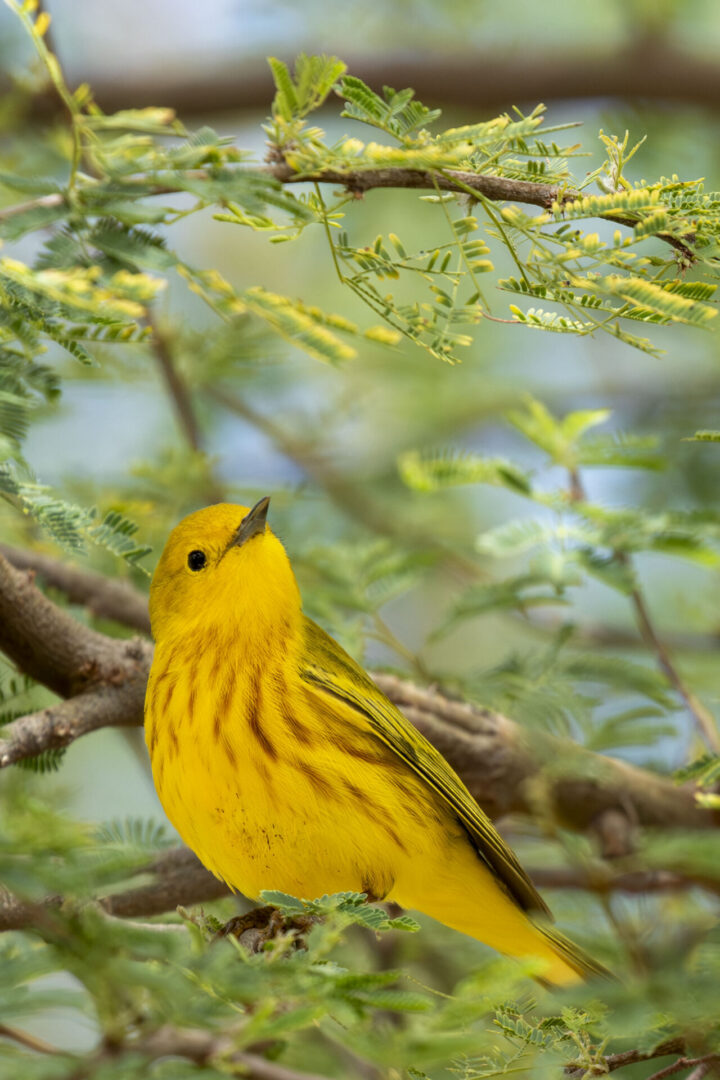
Adult yellow warblers are about five inches long, making them smaller than a sparrow. Males are bright yellow with reddish-brown streaks on their chest, while females are usually a softer yellow with fewer streaks. Their thin, pointed bills are perfect for catching insects, and their dark eyes stand out against their golden feathers.
One of the most recognizable features of the yellow warbler is its cheerful song. Birdwatchers often describe it as sounding like “sweet-sweet-sweet, I’m-so-sweet.” Males sing this frequently during the breeding season to attract mates and defend their territory. Their lively songs can often be heard from cottonwood and willow trees throughout the wetlands.
Yellow warblers prefer habitats with dense shrubs and trees near water. In the Park, they are commonly found in riparian areas with willows, cottonwoods, and other native vegetation along ponds, streams, and marshes. These plants provide shelter, nesting sites, and protection from predators.
Their diet consists mainly of insects such as caterpillars, beetles, flies, mosquitoes, and spiders. They move quickly through branches and leaves, carefully searching for prey. Occasionally, they also eat fruits and small berries, such as Anderson’s wolfberry. By consuming large numbers of insects, yellow warblers help maintain a healthy balance in the wetland ecosystem.
During the breeding season, the female builds a small cup-shaped nest made from grasses, bark fibers, and plant materials. The nest is usually hidden among branches near water. Females typically lay three to five eggs and incubate them for about two weeks. After hatching, both parents work together to feed the hungry nestlings until they are ready to leave the nest.
Yellow warblers face many challenges in the wild. Predators include snakes, hawks, owls, domestic cats, and larger birds. They also have a unique defense against brown-headed cowbirds, which sometimes lay their eggs in yellow warbler nests. In some cases, the yellow warbler parents recognize the intruder’s egg and build a new nest layer directly over it. This unusual behavior helps protect their own young and is one of the species’ most fascinating adaptations.
Keep an eye out when you walk the Park’s Nature Preserve, especially in the riparian habitats. If something yellow wrestles the lower vegetation areas near ponds and streams, you may have spotted one!
– By Constance Carlson, Director of Communications; photo by Alex Harper, Nature in Mind (www.natureofmind.org).
Please enjoy these YouTube videos:
Yellow Warbler Singing 0:08
How to ID Yellow Warblers 0:20