
The Beavertail Cactus
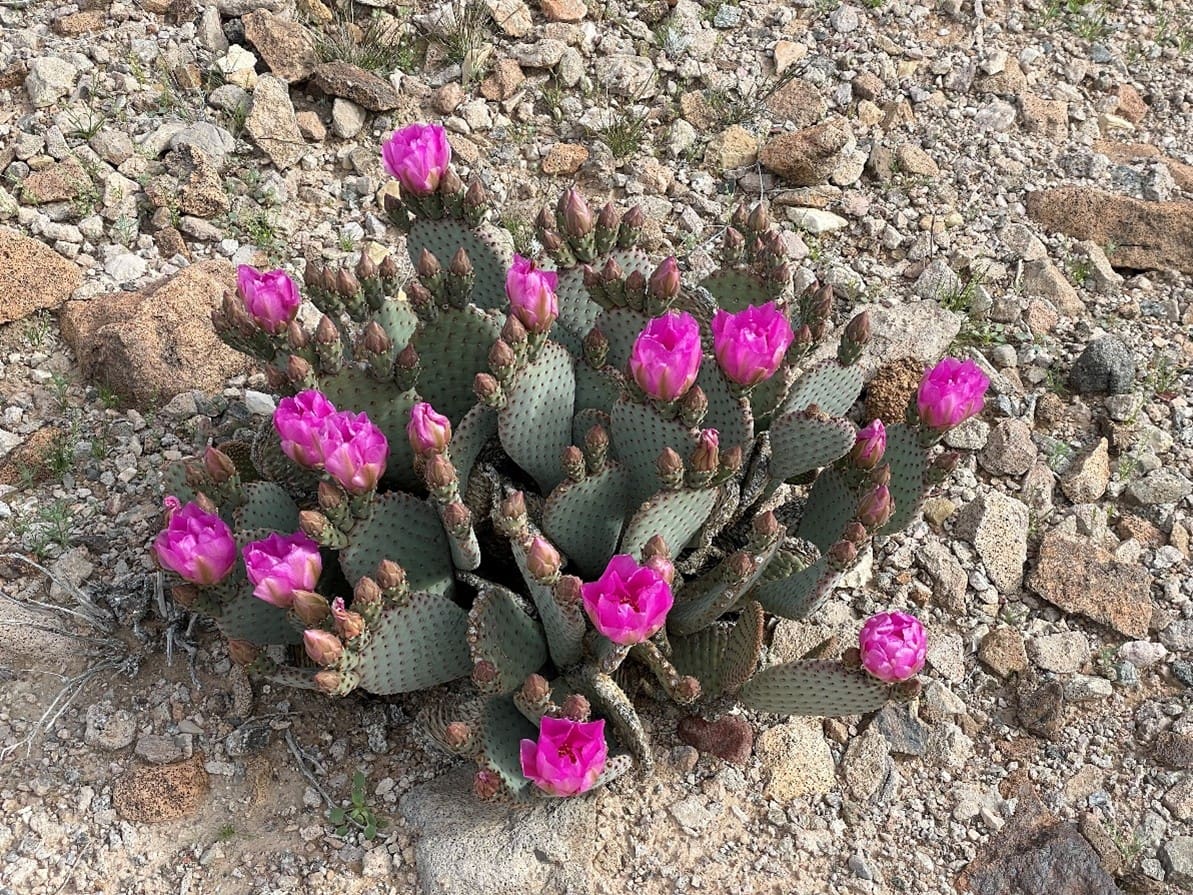
| SOFT VELVETY FRECKLES? DON’T PET THIS PLANT TO FIND OUT! |
| Beavertails may not have the long spines characteristic of many cactus species, but their tiny barbs (called glochids) that are clustered in fuzzy-looking bunches are anything but “fuzzy!” They detach from the plant at the slightest touch, range from very annoying to quite painful, and are hard to extract from skin (with tweezers) or clothing (with tape). The beavertail is a member of the most abundant and widespread cactus genus – Opuntia. There are eight native species with four varieties in the coastal, mountain and desert habitats of California and Nevada alone. They have been here for a while – fossilized packrat middens (dunghills) in Death Valley dating to about 19,500 years ago contain evidence of the beavertail – and they are superbly adapted to life in the heat and drought of their desert home. Wait – did I say “desert?” Yes. Clark County Wetlands Park does have a dry side! The beavertail cactus is just one member of the desert scrub plant community found uphill and north of the green riparian corridor that follows the Las Vegas Wash down slope through the Park toward Lake Mead. These low-growing cactus plants with their blue-green to purplish flat pads are most noticeable during the spring blooming season, when their many lovely pinkish to magenta blooms “pop” against the browns and dark greens of neighboring plants, and provide a colorful contrast to their plump, well-hydrated pads. The flowers will develop into cactus fruits called “cactus apples,” and the pads will shrivel and wrinkle during periods without rain, so spring is really “prime time” to catch the show. Like most species of cactus, the beavertail uses CAM (Crassulacean acid metabolism) photosynthesis, which allows the plants to photosynthesize during the day while opening the pores in their stems (called stomata) to take in carbon dioxide only at night. By keeping the stomata closed during the day and opening them at night, cactus plants minimize water loss. In extreme drought conditions, they can even photosynthesize at “idle” by internally recycling carbon dioxide and keeping the stomata closed night and day! Since these drought-period cactus plants are not completely dormant, they can “jump start” into normal photosynthesis and start quick growth as soon as they receive rain. Though their flowers are indeed beautiful, beavertails are not just “pretty faces.” For centuries, the cactus were an important food source for Native American societies. All the above-ground parts of the plants are edible (once the clumps of glochids have been removed by rubbing the plants in sand or brushing them carefully with handfuls of grass). Young pads, flowers, and fruit could be boiled fresh, steamed in earthen pits lined with hot stones, or dried and stored for later use. Sometimes pulp scraped from inside the fleshy pads was used to dress wounds and changed several times a day. Beavertail fruit and pads are still eaten by humans today, and they are also eaten by wildlife, including desert tortoises, ground squirrels, desert woodrats, and jackrabbits. Various species of native bees pollinate the flowers. If you take a close look at the pads you will often see populations of green sapsucking bugs dining on cactus juice. Birds, small mammals, and reptiles find shelter and nesting sites among the glochid-protected pads. As if all this were not enough, beavertail cactus plants even help to control erosion in the arid environments where they grow. Those who bicycle the loop trail at the Park will have the opportunity to check out beavertail cactus (and other lovely spring flowers) as they ride at this time of the year. For those who prefer to walk, beavertail and many other beautiful spring desert blooms can easily be seen along North Shore Road at Lake Mead National Recreation Area, not far from the Park. – By Chris Leavitt, President; photo credit: Christie Leavitt |
Please enjoy this YouTube video: