
The Black-tailed Jackrabbit
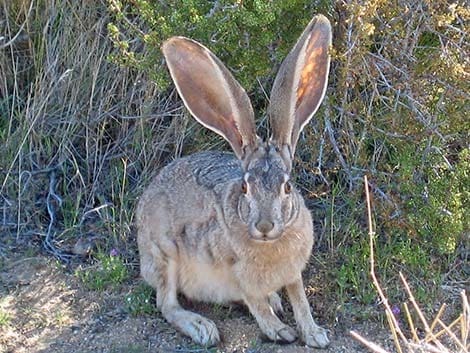
WHAT WETLANDS PARK “CRITTER” IS LABELED A RABBIT, BUT IS ACTUALLY SOMETHING ELSE?
Even though it’s called a “rabbit,” the black-tailed jackrabbit (Lepus californicus) is actually a hare. Hares are in the same family as rabbits but have some key differences from their “cousins,” like the Desert Cottontail (Sylvilagus audubonii). Differences include being born with fur and open eyes and having longer legs for running fast. The black-tailed jackrabbit is common in desert areas like those found in the Clark County Wetlands Park.
A black-tailed jackrabbit has a slender body covered in grayish-brown fur that helps it blend into the desert environment. Both males and females have very long ears with black tips and a black stripe along the back to the tail. Adults usually grow about two feet long and can weigh between three and eight pounds. Females are often a bit larger than the males.
These hares are herbivores, which means they eat plants. They browse on grasses, such as alkalai sacaton and desert saltgrass; shrubs, cacti, and other vegetation that grows in desert scrubland. In the spring and summer, they eat softer green plants and buds, and in the fall and winter they feed more on dry plants, bark, twigs, and woody stems. Jackrabbits get much of the water they need from the plants they eat, so they do not need to drink water very often.
Black-tailed jackrabbits do not live deep in burrows like some rabbits. Instead, they make shallow depressions in the ground under bushes or in the shade where they rest during the day. Their home areas are usually open spaces with short grasses and shrubs. In the Park, this includes the desert scrub found predominantly outside the Nature Preserve. This arid land is flat; plants grow sparsely but provide enough for the hare’s food and cover.
Because jackrabbits prefer open, dry, and flat land rather than thick forests habitats, it is ideal habitat for them to quickly see predators and escape. This kind of environment puts their powerful hind legs to their best advantage to escape danger.
Black-tailed jackrabbits can mate throughout the year, especially in warm climates like southern Nevada. During mating, males chase females before they leap together and mate. Females may have several litters each year, and each litter can have up to six or more young, called kittens or kits. As the young are born with fur and open eyes, they can hop around shortly after birth. Sometimes the mother places her young in separate hiding places to decrease the chances that a predator will find them all. She stays away from them during the daytime and returns several times a night to nurse the young to avoid attracting the attention of a predator.
Jackrabbits have many predators in the desert. In addition to people, coyotes, foxes, bobcats, hawks, owls, and even large snakes will eat them if they can catch them. For centuries, Native Americas in the southwest hunted jackrabbits in communal fall “drives.” Hunters formed a circle a mile or more in diameter and chased the jackrabbits into a U-shaped trap made of several hundred feet of fiber netting. These drives provided not only meat for the winter, but also soft warm skins to be woven into blankets. Interestingly, archaeological evidence indicates that individual jackrabbits were statistically larger about 600 years ago than they are currently.
To avoid being eaten, jackrabbits use several techniques, including “freezing” when they are spotted (used primarily with coyotes and foxes) and fast running—sometimes in zigzag patterns. They can run up to about 30 to 40 miles per hour in short bursts. Their keen sense of hearing and sight provide an early warning system, enabling the jackrabbits to spot predators before they get too close.
Hares are mostly nocturnal, which means they are most active in the early dawn and evening and at night. During the day, they rest in shallow spots under plants to stay cool and safe. At night, they go out to forage for food when it is cooler and there is less danger from heat and some daytime predators.
While you might not be able to see these critters “active” during the day when the Park is open, you may possibly see them resting underbrush on the dry side of the Park. And, you can assume that the hares will be active after dusk.
– By Constance Carlson, Director of Communications; photo by Jim Boone, https://www.birdandhike.com.
Please enjoy these YouTube videos:
Black-tailed Jackrabbit Hopping through the Mesquite Bosque in Sunset Park Las Vegas, Nevada
Black-tailed Jackrabbit (Lepus californicus) in Nevada Desert. Зайцы Невады. 02:11